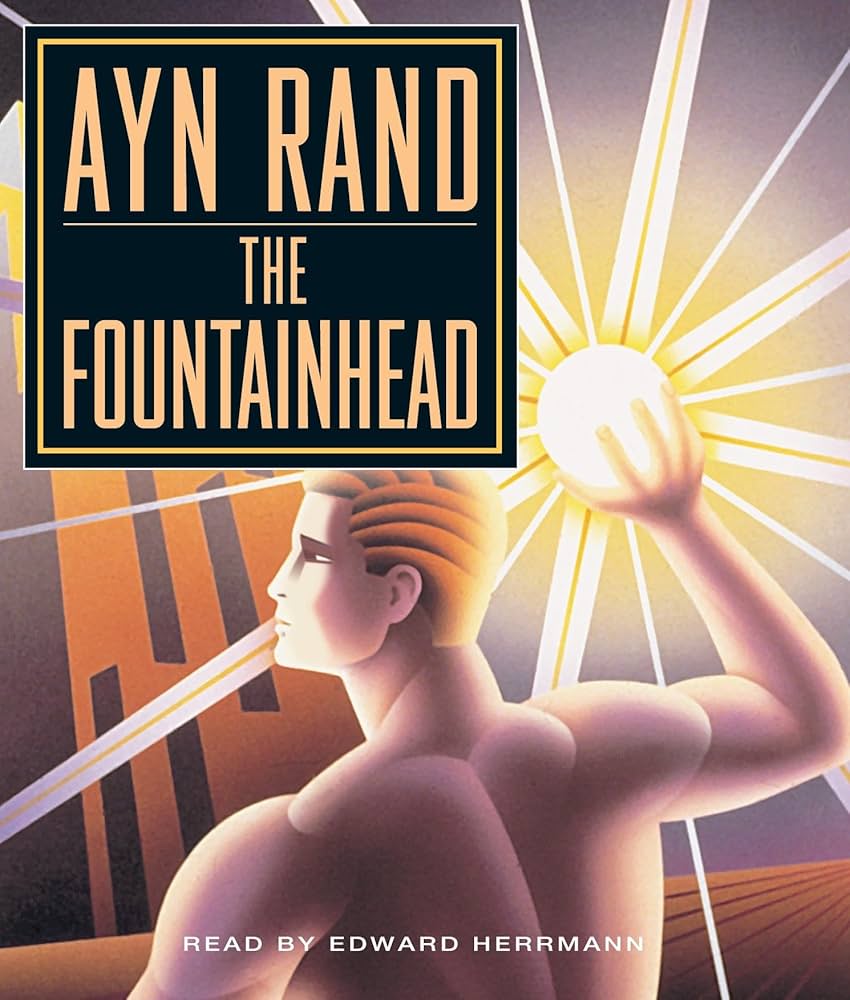
Architect of the Self: Characterization in Ayn Rand’s The Fountainhead
When most people talk about Ayn Rand’s The Fountainhead, they talk about its philosophy. And while its Objectivism pulses through every line, what makes the novel endure is not just the ideas, it’s the way those ideas are built into the characters’ bones. Rand doesn’t just argue; she personifies her philosophy, letting it course through the veins of each character she brings to life.
Howard Roark: The Human Blueprint
Howard Roark is not simply just a rebellious architect in the novel, but he is a complex architectural idea in human form. His design principles mirror his moral ones, as he believes and exudes that form follows function,and authenticity powers over imitation in the society he is stuck in.
As Roark tells Austen Heller:
“I don’t intend to build in order to have clients. I intend to have clients in order to build.”
This inversion captures his role in the novel: creation for its own sake, not for the sake of approval. Rand uses Roark’s uncompromising standards to embody her central ideal, in that the individual’s integrity is non-negotiable and one of the only true ideals he can hold onto, as it is the only thing he has control over.
Dominique Francon: The Mirror and the Challenger
Dominique is often misunderstood as contradictory, as her whole existence as a character acts as a kind of paradox in itself. She both loves Roark and works to destroy him, grappling with the struggles of the reality of her society and her own personal beliefs that she holds. Though she eventually develops and realizes that Roark can never be destroyed, she goes through a journey of living this contradiction at an extreme. But through a literary lens, she’s not necessarily inconsistent, as she’s the embodiment of the conflict between greatness and a corrupt society.
Her paradox is summed up in her own confession to Roark:
“I love you, Roark. I’m going to destroy you.”
She fears that the world will tear him down, so she’d rather do it herself than watch him be destroyed by mediocrity, because she doesn’t believe that they deserve to even have the opportunity to observe his greatness to the point where they can destory him. Her arc is less about changing her beliefs than about finding the courage to live them openly, aligning herself with Roark in the end.
Ellsworth Toohey: The Voice of the Collective
If Roark is an architectural drawing in flesh, Toohey is the smudge on the blueprint. And as an antagonist, he doesn’t attack Roark with overt villainy but with quiet, systematic corrosion, championing “selflessness” as a way to control and diminish true individuality.
He reveals his method when he tells Peter Keating:
“Don’t set out to raze all shrines — you’ll frighten men. Enshrine mediocrity — and the shrines are razed.”
Toohey’s arguments often sound reasonable until examined closely. This makes him an effective literary foil: he is everything Roark is not, indirect, manipulative, and derivative.
Narrative Style: The Architecture of Prose
Rand’s prose is unapologetically declarative. She doesn’t hide her thematic scaffolding, she lets the reader see the beams. The speeches she writes stretch for pages, her metaphors are blunt, and her characters speak in polished philosophy rather than naturalistic dialogue, exuding her beliefs throughout the entire novel. Each character serves as a different facet or counterargument to her philosophy.
In Roark’s closing courtroom speech, Rand uses the stylization to crystalize the novel’s theme:
“The creator’s concern is the conquest of nature. The parasite’s concern is the conquest of men.”
The deliberate grandiosity of such distances the novel from realism, but also gives it the enduring, almost mythic quality that a modern epic needs.
Why It Works as Literature
Even if one disagrees with Rand’s philosophy, The Fountainhead offers a masterclass in thematic integration. Every setting, object, and conversation Rand crafts feeds the central question, of What is the role of the individual in a world that demands conformity?
As Roark says to Gail Wynand:
“The question isn’t who is going to let me; it’s who is going to stop me.”
Whether one sees him as hero or ideologue, Roark’s voice and the novel’s in itself, is unforgettable.
Question for Readers:
Do you think a novel can succeed as literature if its characters are deliberately “idealized” rather than realistic? Or does that limit its emotional truth?
 Literature Analysis
Leave a comment