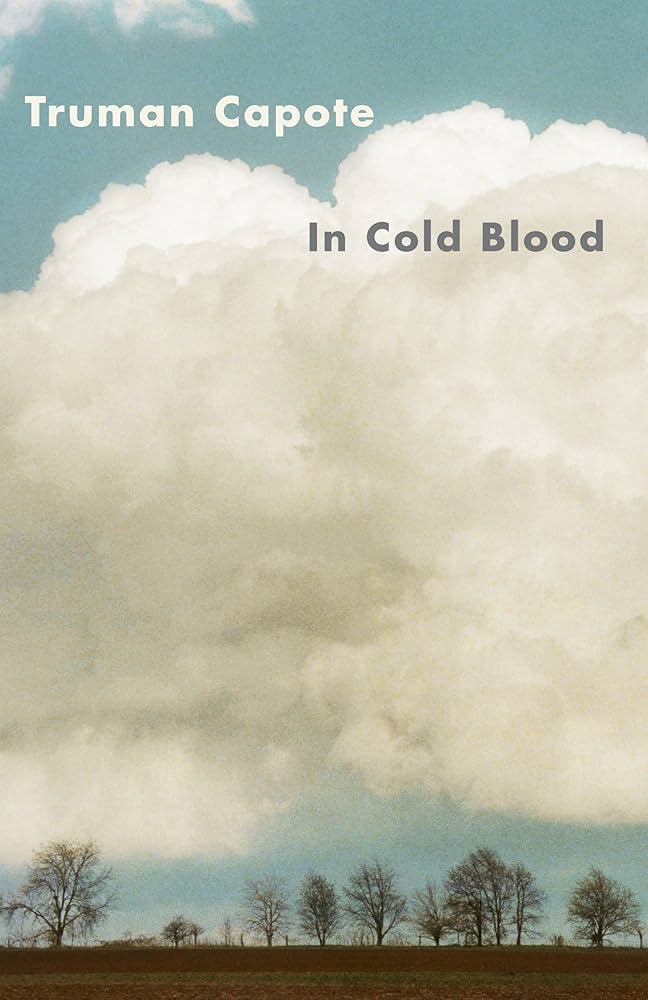
When Truman Capote published In Cold Blood in 1966, he didn’t just change the narrative for how crimes could be recounted, he redefined the way crime could be written. The brutal murder of the Clutter family in Holcomb, Kansas, may have been covered in newspapers and court documents, but Capote’s project was bigger, taking the tools of fiction and applying them to a fact, something that had never been done before. The result was what he went on to call a “nonfiction novel,” though his work blurred the boundary between journalism and literature, changing both forever.
The Birth of the Nonfiction Novel
Before Capote, reporting on crime was factual, concise, and astringent. In Cold Blood is read almost as a novel, with its pacing, character build-up, and plot progression, developing the back-story of each of the players, as Capote not only immerses the reader in the crime but also in the lives of the Clutters, their town, and even their killers, Perry Smith and Richard Hickock.
This was newsworthy in that Capote not only was knocking down more information about what happened, but he was shaping it into a story. Claiming all the information to be fact, he invested painstaking amounts of time studying interviews and documents, refining his writing style to take the facts he did uncover and fashion them into a novel that read like prose, thus creating a new genre, long-form narrative nonfiction, true crime made literary.
Style as Substance
What makes In Cold Blood feel like literature isn’t simply the length or the research, it’s Capote’s style and detail. He writes scenes cinematically, shifting perspectives between the Clutter family, the killers, and the investigators, building suspense even when readers already know the outcome going into the book.
For example, his description of Perry Smith reads to be almost sympathetic, and could even be described as lyrical:
“His voice was both gentle and prim — a voice that, though it was not meant to be, seemed nevertheless patronizing, a voice that, like his handwriting, was more elegant than his appearance warranted.”
Capote renders Perry with the depth of a tragic character, not a flat villain. This at first, could have been seen to be controversial because readers asked if he was humanizing a murderer too much? However, this literary approach was the exact reason that allows the book to endure.
By forcing his readers to sit with complexity rather than easy moral categories, Capote was able to emphasize the true tragedy in the situation whilst also providing the details that allowed the killers, the victims, and even the town of Holcomb to emerge as fully human, rather than as stock figures in a crime story.”
Capote’s genius wasn’t only in portraying the killers or the victims, which was new to readers, but his genius also lied in the fact that he expanded the lens of his story to include EVERYONE touched by the crime. Giving us pages of details on Detective Alvin Dewey, the Kansas Bureau of Investigation agent assigned to the case, not just as a professional but as a husband and father, we learn about how his long nights of investigation strained his marriage, his health, and even how his children saw the world as they overheard whispered conversations about murder. By this in depth research, Capote was able to show how the shadow of the case bleeds into the private life of a family that never even knew the Clutters personally.
This was radical for true crime writing, because before, when stories were told about murders, people tended to focus more exclusively on the brutality of the act itself or on the personalities of the perpetrators. While that is not wrong, the supporting figures such as the detectives, neighbors, and jurors, have always faded into anonymity, though still being highly affected and even traumatized. Capote refused to continue erasing the stories of those who were involved at smaller scales, insisting that their humanity matters too, and that the “collateral” people in a tragedy carry wounds that are often invisible.
That level of detail could be part of why the book was and remains so controversial, as some critics could argue that Capote was intruding too deeply by exposing too much, and weaving in all these other people from the community. But I believe this is precisely what made the book so important, as by weaving together the killers’ psychological complexity, the victims’ daily lives, and the unforeseen consequences for everyone connected to the case, Capote created a kind of journalism that was unprecedented in scope that also raised more awareness.
Capote introduced this journalism that held the density of a novel, being layered, detailed, and emotionally textured. Allowing readers to feel the gravity and depth of each situation, not just the horror of the crime scene itself, he created this new genre that allowed journalism and fiction to almost coexist, despite coming from opposite sides of literature. Showing the way murder rearranges a community’s sense of safety, altering family dinners, and lingering in the minds of strangers who never met the Clutters, Capote invited his readers to consider how killers plan and rationalize, how motives form, and how violence is rarely random but shaped by patterns of thought and circumstance.
Why It Matters
By writing crime as literature, Capote expanded what readers expected from nonfiction, showing that true facts could be as gripping as fiction was if it was shaped with more narrative care and structure. His level of immersion influenced everything that came after, from long-form magazine reporting to the explosion of narrative true crime podcasts. Capote’s work showed that facts didn’t need to be dry; they could be rendered with the depth of literature, and in doing so, they could change how society remembers and processes violence. His influence through this novel can still be seen today, from long form magazine features, to podcasts like Serial, and even Netflix docuseries today. The “true crime boom” owes its birth to Capote’s experiment with In Cold Blood.
At the same time, however, his work raises ethical questions that are still relevant when thinking about the evolution of the true crime genre in media content today: where is the line between storytelling and exploitation? Can a writer or storyteller ever be completely objective when turning lives and deaths into a narrative? These debates are part of Capote’s legacy too, and are important to consider when consuming true crime content. It is important for consumers to realize that while these types of content carry some small “entertainment” factor, it shouldn’t be for entertainment, but for awareness.
Why In Cold Blood Was So Controversial
For all its literary brilliance, In Cold Blood has always lived under a cloud of controversy. Even though Capote insisted that every word was true, claiming he had “invented nothing”, close readers and critics later pointed out some discrepancies. The most famous is the graveyard scene at the end of the book, in which detective Alvin Dewey supposedly speaks with Nancy Clutter’s friend beside her grave, a moment of closure that was never confirmed to have actually happened. Other details, like Capote’s depiction of Bonnie Clutter’s depression or the speed with which Dewey pursued key leads, were disputed by survivors and colleagues.
Even more debated was Capote’s sympathetic portrayal of Perry Smith. Some scholars argue Capote projected elements of himself onto Smith, making him more articulate, intellectual, and poetic on the page than in real life. The result is a murderer who reads less like a one-dimensional criminal and more like a tragic anti-hero. Was this literary empathy, or artistic distortion? That question still divides critics.
Capote and Perry Smith: A Destructive Bond?
Another controversy was the fact that Capote himself was unusually close to Perry Smith. Capote interviewed Smith in prison for years, going there often to conduct long interviews and even helping him with his appeals. Both men came from eerily similar backgrounds, having had broken childhoods, having been abandoned by their parents, and being extremely imaginative men. That identification with brokenness could have established a bond greater than reporting.
Even some of Capote’s biographers are so far as to hold that Capote did love Smith, or became enamored with him at least. Whether or not that is true, it is at least sure that Capote’s emotional involvement could have affected what he wrote. Capote’s depiction of Smith is sympathetic, even loving, presenting him as more a victim of circumstance than as a cold-blooded killer. Critics debate whether this closeness violated Capote’s objectivity or allowed him to paint a richer and more compassionate picture than crime reporting had previously been able to.
Legacy of Controversy
These questions of fact, objectivity, and of the lines getting blurred between fact and fiction are as much a part of In Cold Blood’s heritage as the book itself. Capote brought literature and journalism into the same room, but the tension between the two was never resolved. His book raised the stakes for writing true crime, but left us with uncomfortable reservations about what it means to tell the truth.
Conclusion
In Cold Blood forever changed the way true crime would be documented. Capote proved that storytelling could deepen our understanding of real events, forcing us to confront not just what happened, but who people were, as victims and killers alike. In doing so, he built a new kind of book where fact and art would have the chance to live uneasily side by side, as life often can be.
Question for Readers:
Do you think true crime works best when told with literary flair, or should it remain closer to straightforward journalism?
 Literature Analysis