
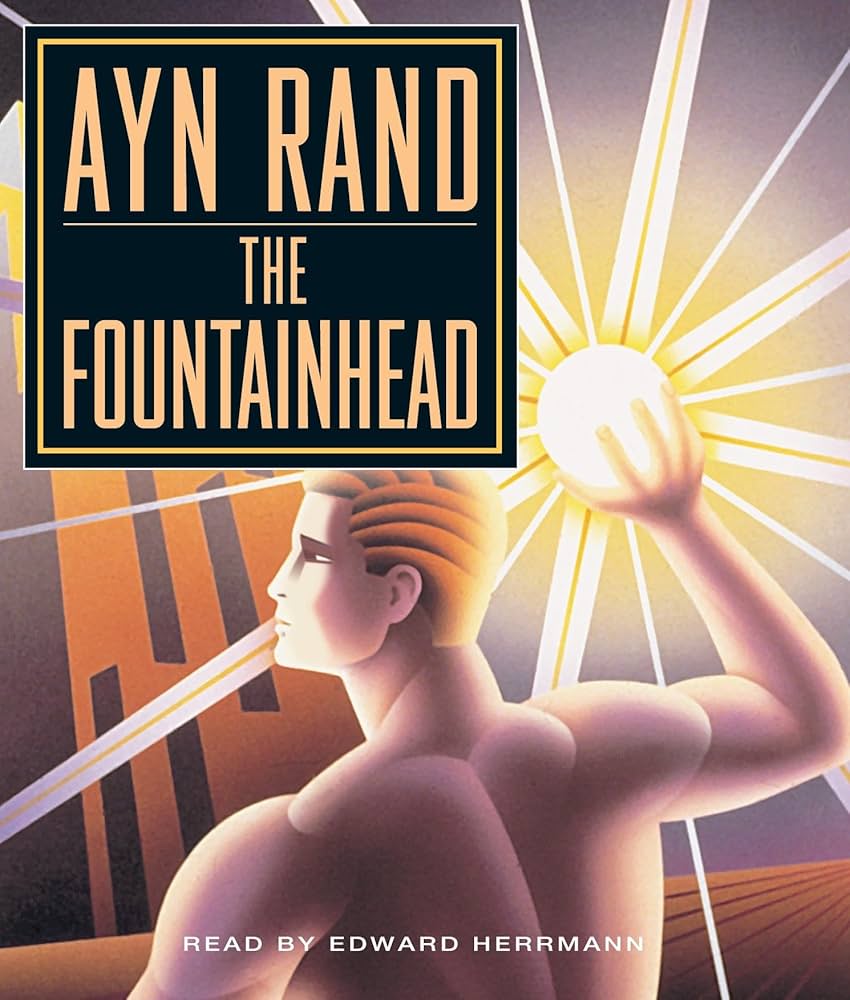
Though Ayn Rand published The Fountainhead in 1943 and Atlas Shrugged in 1957, the two novels are less like distant siblings and more like different iterations of the same architectural blueprint. They both construct entire worlds around uncompromising individuals, people who live and breathe creation, and both novels dramatize the friction between the solitary genius and the weight of a society that demands conformity and normality.
After reading The Fountainhead, I immediately picked up Atlas Shrugged to see if they would be similar at all. Read side by side, the novels feel almost like drafts of the same story written at different scales, one being more intimate, the other epic, affecting characters on a much larger scale. Instantly being able to connect parallels to each other, I realized that the two stories were so much more similar than they let on to be.
The Fountainhead can be described as more like a single skyscraper, its foundations are set firmly in one man, Howard Roark’s story, while Atlas Shrugged is more focused upon the destiny of a sprawling industrial city, layered and expansive, populated by dozens of characters but still echoing the same structural lines.
The Protagonists: Architects of More Than Buildings
In The Fountainhead, Howard Roark builds skyscrapers, his raw materials being stone, steel and glass, and his battlefield being the skyline of New York and its architectural society. In Atlas Shrugged, Dagny Taggart builds railroads, forging paths across a collapsing America. On the surface, their tools differ, beams versus tracks, but in Rand’s narrative architecture, both are master builders who refuse to compromise on vision.
For Roark, architecture is not a profession; it is an act of self-expression. He tells Austen Heller:
“I don’t intend to build in order to have clients. I intend to have clients in order to build.”
This reversal captures the essence of his philosophy in that he believes creation comes first, and the world has only the choice to adapt or fall away. Dagny could have said the same in her defense of the John Galt Line, in her desperate efforts to keep their trains running when the rest of society crumbles. For both, work is not a means to an end but the end itself, and the justification for existence.
Rand gives her protagonists different contexts but almost the same DNA. Both are uncompromising creators, standing as counterpoints to a world where compromise is celebrated as virtue.
The Antagonists: Voices of the Collective
Rand’s villains are rarely monsters in the traditional sense; they are often smooth, persuasive, and cloaked in moralistic rhetoric. Ellsworth Toohey in The Fountainhead and James Taggart in Atlas Shrugged share this slipperiness. They preach values that sound noble in theory, such as selflessness, service, and equality, but they use them as weapons to undermine excellence, in execution being more than just noble beliefs.
Toohey’s method is summed up in one of his most chilling lines to Peter Keating:
“Don’t set out to raze all shrines — you’ll frighten men. Enshrine mediocrity — and the shrines are razed.”
This encapsulates Rand’s warning, showing a lesson to her readers that evil doesn’t always attack openly, because sometimes it can act in whispers, manipulating and elevating the ordinary until greatness becomes unrecognizable behind the scenes.
James Taggart employs the same strategy in Atlas Shrugged, hiding his mediocrity behind moral slogans, railing against “selfishness” and praising “the public good,” but deep down knowing that his true aim is to protect himself from competition, cloaking any fear he has as virtue and power, and ultimately fooling readers and characters alike about his true motives. The effect in both novels are the same, showcasing the sides of antagonists who don’t build anything by themselves, but feed parasitically on the accomplishments of others in their society.
The Love Interests as Philosophical Foils
Rand doesn’t treat love as sentimental ornament in her novels, because she uses them as functions of another arena where her and her character’s philosophy is tested. Dominique Francon in The Fountainhead and Hank Rearden in Atlas Shrugged serve similar narrative functions: they challenge the protagonist’s ideals by embodying the tension between personal loyalty and societal pressure.
Dominique’s apparent betrayal of Roark, and her desires to destroy him are not rooted in malice only, but also in despair. Her attempts to ruin him aren’t so much rooted in her pure hatred of him, but more as a reflection of her hatred for society. She believes greatness cannot survive in a corrupt world, so she tries to destroy what she loves before others can, believing that they do not even deserve to witness his greatness and advance to the stage where they attempt to destroy him. Roark’s response to her is to remain unshaken, proving that his work, not her approval or disapproval, defines him, and he is indestructible.
Rearden’s arc is different but no less revealing. At the beginning of Atlas Shrugged, he is a man divided, being a titan at work, but a guilty conformist at home. His affair with Dagny Taggart comes to the point where he learns to reject the false moral guilt imposed on him by society. By choosing Dagny and his own values over the demands of the looters, he finally integrates his life.
In both cases, love is not a distraction from the work but a crucible, as it serves as a foil that sharpens Rand’s characters rather than softens them, forcing the heroes to clarify who they are when measured against another person, and if their beliefs will dwindle or not.
Narrative Scale: One Blueprint, Two Sizes
Perhaps the most striking parallel between the novels is their scale. The Fountainhead is a tightly focused skyscraper, showing how one man’s life can become a case study for Rand’s ideals. It is narrow but tall, rising with singular intensity. Atlas Shrugged on the other hand is a sprawling industrial city, multi-layered, chaotic, full of highways, factories, boardrooms, and political intrigue.
Yet the blueprint is the same, as they both introduce the uncompromising creator, pit them against collectivist antagonists, force them through personal and professional trials, and finally end with their vision vindicated and unbroken. The important difference between these two is that The Fountainhead shows this pattern on the scale of one man’s career, while Atlas Shrugged magnifies it to the scale of an entire civilization, magnifying its impacts to multiple states and within the whole industry.
Why the Parallels Matter
Taken together, the two novels reveal how Rand refined her literary vision. The Fountainhead asks: Can one person remain true in a corrupt world? Atlas Shrugged escalated those stakes, asking What happens to the corrupt world when all the true persons leave?
In both cases, the answer is the same, in that while the world may collapse without its builders, the builders themselves often endure with the motivations of persevering and staying true to their values. Creation survives because integrity survives. The physicality of the skyscrapers designed may topple,and the railroads built may rust, but the spirit that conceived them proves to be indestructible to the end.
Seen this way, Atlas Shrugged is not just a sequel in spirit to The Fountainhead but a necessary expansion. Rand began by showing us the individual who cannot be broken, then showed us the society that breaks when it drives such individuals away.
Question for Readers:
If you’ve read both novels, which protagonist do you find more compelling — Roark, the man who never wavers, or Dagny, the woman who fights to hold a collapsing world together?
 Literature Analysis